
Grain screening, on site
Grain quality, kernel by kernel.
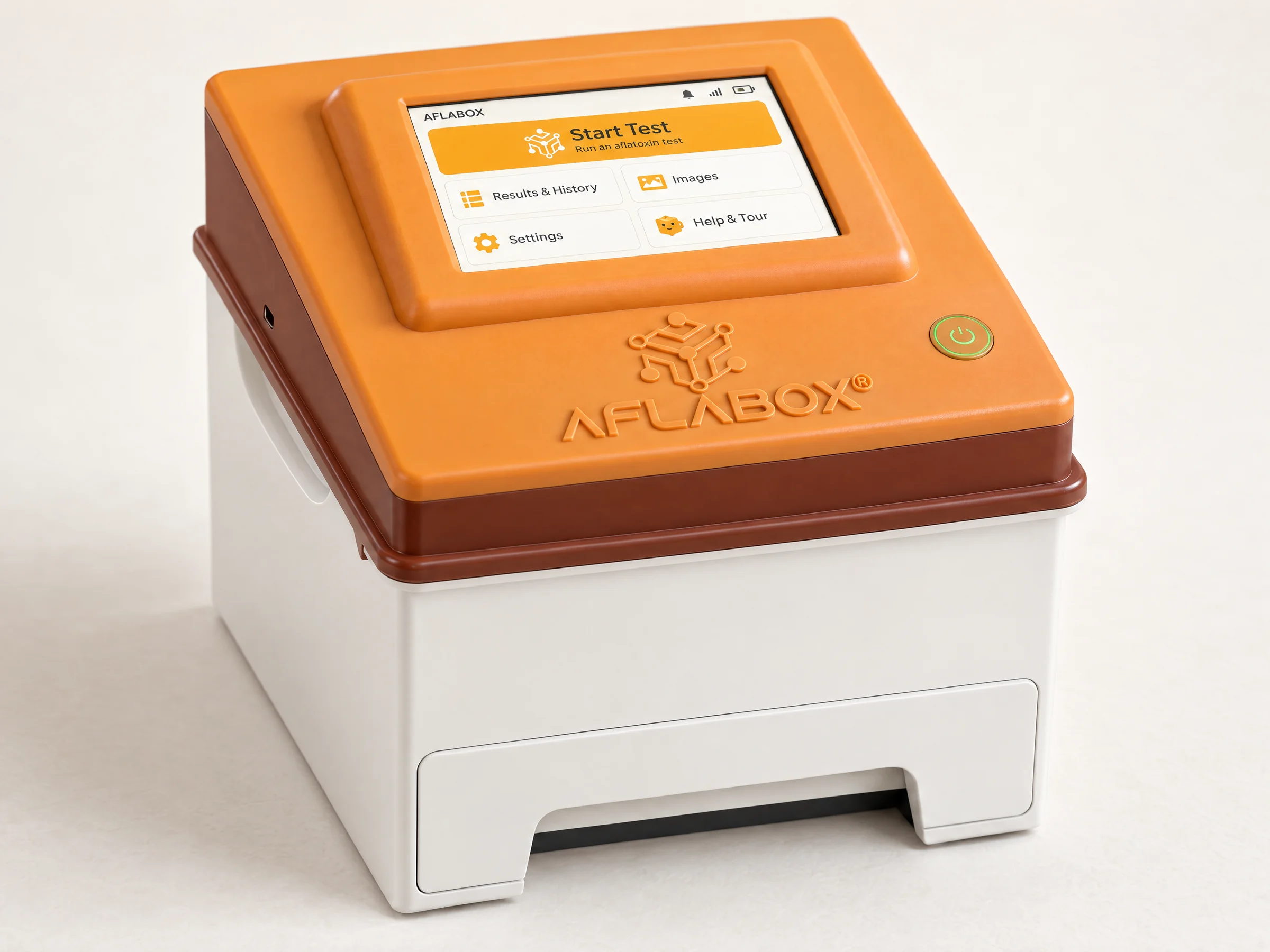
Aflabox images a grain sample under white and ultraviolet light and assesses it kernel by kernel on the box, with results in your dashboard.
The problem
Mycotoxins are common, and hard to see.
Aflatoxin, produced by moulds on maize and other crops, is one of the most serious. Three figures from the research:
-
Up to 60–80%
of food crops have detectable mycotoxins. About 25% exceed EU or Codex limits.
Source: Eskola et al., 2020
-
97%
of 1,255 retail maize flour samples from ten urban sites in Kenya (2021) contained detectable aflatoxin. 16% exceeded the national 10 ppb limit.
Source: Hoffmann et al., 2025
-
4.6–28.2%
of new liver cancer cases worldwide each year, 25,200 to 155,000 cases, may be attributable to aflatoxin.
Source: Liu & Wu, 2010
Lab test and Aflabox
Most of the error comes from the sample.
Aflatoxin sits in a small number of kernels, so the sample drawn from a lot may miss them or overstate them. When a corn lot is tested in the laboratory, the sample itself accounts for most of the uncertainty.
1.13 kg sample, 50 g subsample, liquid chromatography. Source: Johansson, Whitaker et al., 2000
Because contamination is skewed toward a few kernels, researchers have proposed looking at single kernels, including with fluorescence imaging.
Source: Chavez et al., 2020
| Laboratory test | Aflabox | |
|---|---|---|
| What is examined | A small ground subsample | Each kernel in the drawer, imaged |
| Where | At the laboratory; the sample is shipped | On site |
| Time to result | Depends on transport and the laboratory; often days | While you wait |
| Sample after testing | Ground and used up | Intact; can be kept, retested or sent on |
| Output | Aflatoxin concentration of the subsample | Images and per-kernel quality grades, in the dashboard |
| Role | Reference measurement | Screening and triage |
Screen lots on site, and send the ones that need a reference measurement to a laboratory.
How it works
Load the sample, capture it and see the result.
-
Sample
One flat layer of grain in the drawer; drawer closed.
-
Capture
Three images: white light, UV 365 nm, UV 385 nm.
-
Analysis
On the box: find each kernel, identify the crop, grade the kernel.
-
Result
On the screen, then in the dashboard with every image.
Crops and quality models
Not only maize.
The box identifies maize, rice, wheat and sorghum, and a quality model for each crop grades the kernels it finds, from normal to mouldy, broken or attacked by pests. We keep building models: any crop can be added once there is enough labelled training data, and we are working on scoring samples against your own quality requirements.
- Maize
- Rice
- Wheat
- Sorghum
Who it is for
Built for the people who handle grain.
Cooperatives and aggregators
Screen members' grain at the collection point, before lots are mixed.
Food processors
Check incoming deliveries on site and decide which lots to send for laboratory testing.
Traders
Screen lots before buying or shipping, with images and results kept in one record.
Regulators and monitoring bodies
Screen more samples in the field and target laboratory analysis where it counts.
Our mission
Grain testing that travels to the grain.
We want food-quality screening to be accessible and portable, from small farms to large processors, so more grain is checked closer to where it is grown, bought and sold.